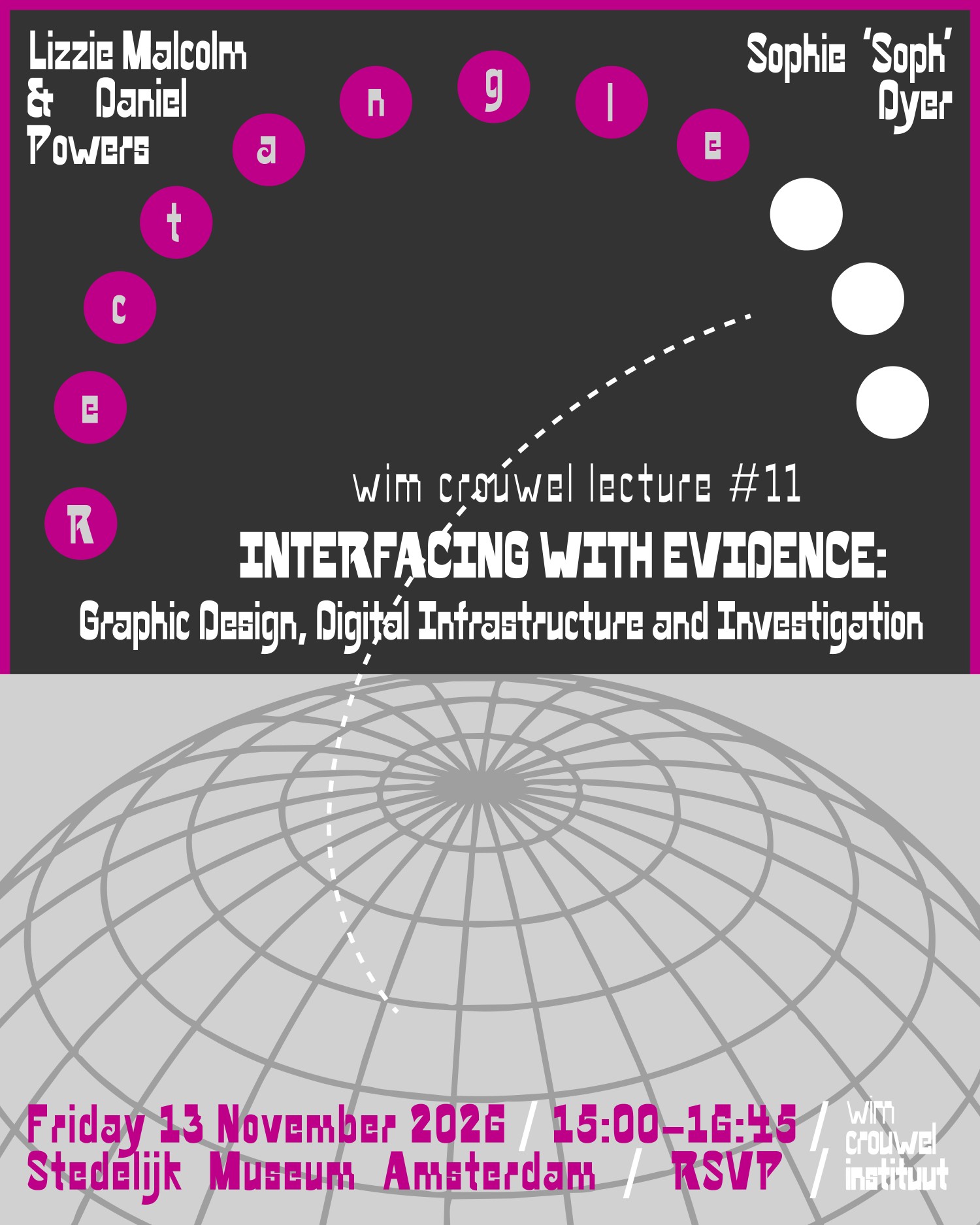
Wim Crouwel Lecture #11
13 November 2026
Interfacing with Evidence: Graphic Design, Digital Infrastructure, and Investigation
DATE: Friday, 13 November, 2026
LOCATION: Stedelijk Museum Amsterdam, Museumplein 10, Teijin Auditorium
SPEAKERS: Lizzie Malcolm and Daniel Powers (Rectangle)
RESPONDENT: Sophie 'Soph' Dyer
Free entrance, but RSVP is required. Please send an email to [email protected]
PROGRAMME
15:00 Registration and doors open
15:30 Main speakers Lizzie Malcolm and Daniel Powers (Rectangle), followed by respondent Sophie 'Soph' Dyer, and a Q&A
16:45 End of the programme
'Interfacing with Evidence: Graphic Design, Digital Infrastructure and Investigation'
What role do tools and archives play in a human rights investigation? What happens to evidence on its way from a satellite image to a courtroom? When is building digital infrastructure an act of solidarity? Glasgow-based studio Rectangle addresses the urgent, technical, and political work of building and maintaining systems for documentation, annotation, and presentation of evidence.
Rectangle collaborates with organisations documenting conflict, human rights abuses, and climate breakdown. These projects have made possible the capture, verification, storage, and publication of diverse collections of satellite images, witness testimonies, incident assessments, maps, videos, and more.
Drawing on their work with Forensic Architecture, a research agency investigating human rights violations, including in Gaza; Airwars, which monitors civilian harm in conflict; and Open-weather, a network that images the Earth’s weather using DIY satellite technology, Lizzie Malcolm and Daniel Powers will look at the tools behind these investigations and the choices that shape them.
Respondent Sophie Dyer, being an investigative designer themselves, will reflect on and react to the issues and methods that Malcolm and Powers have just brought up.
Lizzie Malcolm and Daniel Powers are both designer/developers and founders of Rectangle. Using both established and emergent technologies, their work focuses on building tools to structure stores of information, and interfaces to access them. They work with organisations across a range of disciplines and fields including human rights, journalism, publishing, research, education, and the arts.
Respondent Sophie 'Soph' Dyer is a London-based designer, researcher and educator. Their work uses participation and investigative design to explore anticolonial and feminist approaches to weather, climate and broader social justice issues. Dyer's design practice spans from co-leading the DIY collective open-weather as it captured the last analogue weather satellites' transmissions before their decommissioning by the US National Oceanic and Atmospheric Administration, to managing Amnesty International’s global crowdsourcing initiative and early efforts in open-source research.
The Wim Crouwel Lecture is co-produced between the Wim Crouwel Instituut, Stedelijk Museum Amsterdam and the Allard Pierson, and supported by Pictoright Fonds, het Cultuurfonds and the Amsterdam University Fund.